£1 Minimum Deposit Casinos in the UK: What to Know
 Available in GB
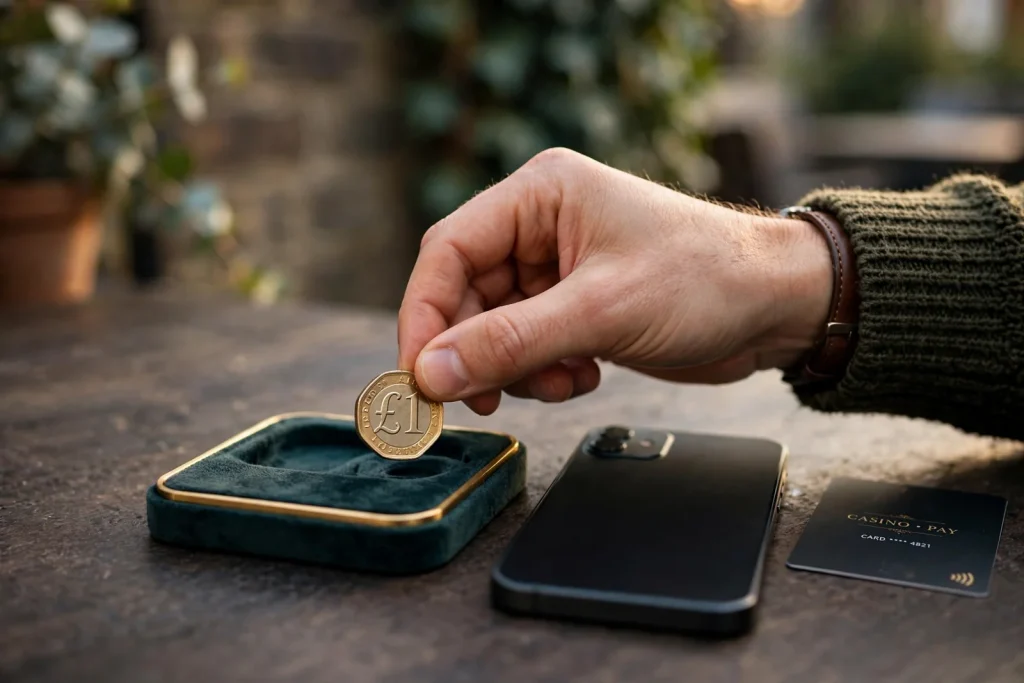
A low cashier threshold does not guarantee every payment route or bonus will accept the same amount.
Table of Contents
- What a £1 Minimum Deposit Actually Gets You
- The Difference Between the Lowest Deposit Tiers
- How to Read a £1 Casino Comparison
- Depositing Online: The Cashier Minimum Is Only One Part
- Real-Money Play on Mobile With a Small Balance
- Bonuses, Free Spins and the £1 Qualifying Deposit
- Slot Stakes and the Pace of a Small Balance
- PayPal and Other E-Wallet Funding Rules
- What “New” Means for £1 Deposits in 2026
- Paying by SMS: Where the £1 Floor Comes From
What a £1 Minimum Deposit Actually Gets You
A genuine £1 cashier minimum means the casino will accept a deposit of that amount into an eligible account. It is a real entry point, not simply a headline attached to a larger required payment. Some UK casinos do accept deposits from £1, although that does not mean every operator does, or that every route into an account will accept the same amount.
I have found it useful to separate three things that promotional wording can blur: the minimum the casino sets, the minimum allowed by the selected payment method, and the amount needed to qualify for a particular offer. The cashier minimum answers only the first question. A £1 figure on a comparison page or in a headline cannot, by itself, establish what will happen when a payment is attempted or whether an extra condition applies.
The distinction matters because the deposit limit is a condition of the account, while the payment route has its own rules. A casino may accept a £1 deposit through an available method but set a higher threshold for another method. Some casinos use one minimum across their payment options; others set a higher floor for bank transfers than for cards or e-wallets. The amount displayed in a general description is therefore not a promise that every route will accept it.
When looking for a UK casino with a £1 minimum deposit, check the available details carefully before choosing. This list provides a limited point of reference: the payout-speed information supplied for each operator.
1. NightWin
Payout speed: 1-3 business days NightWin’s stated payout speed is 1–3 business days. The available information does not confirm its minimum deposit.
2. Chanze
Payout speed: 1-3 business days Chanze’s stated payout speed is 1–3 business days. The available information does not confirm its minimum deposit.
3. BeOnBet
Payout speed: 1-3 business days BeOnBet’s stated payout speed is 1–3 business days. The available information does not confirm its minimum deposit.
4. x3bet
Payout speed: 1-3 business days x3bet’s stated payout speed is 1–3 business days. The available information does not confirm its minimum deposit.
5. Amunbet
Payout speed: 1-3 business days Amunbet’s stated payout speed is 1–3 business days. The available information does not confirm its minimum deposit.
6. EvoSpin
Payout speed: 1-3 business days EvoSpin’s stated payout speed is 1–3 business days. The available information does not confirm its minimum deposit.
7. SpinFormula
Payout speed: 1-3 business days SpinFormula’s stated payout speed is 1–3 business days. The available information does not confirm its minimum deposit.
8. WinBeast
Payout speed: 1-3 business days WinBeast’s stated payout speed is 1–3 business days. The available information does not confirm its minimum deposit.
9. NightLuck
Payout speed: 1-3 business days NightLuck’s stated payout speed is 1–3 business days. The available information does not confirm its minimum deposit.
10. SlotoSport
Payout speed: 1-3 business days SlotoSport’s stated payout speed is 1–3 business days. The available information does not confirm its minimum deposit.
There is another dividing line between getting funds into the account and getting an offer. A £1 payment can be accepted as cash without counting towards a welcome promotion. Promotional terms may require a qualifying deposit above the cashier minimum, or exclude the lowest deposit bracket altogether. In that case, the transaction still funds the account; it simply does not trigger the advertised deal. Those are different outcomes, even if the wording on a promotional page makes them look connected.
This is why “£1 minimum” should be read narrowly. It describes an entry condition, not a complete package. It does not promise that a bonus will attach, that a specific payment method will accept £1, or that a later withdrawal can be made for the same amount. Those details belong to separate terms. Small print, doing its job.
A specialist review recorded six UKGC-licensed casinos as accepting genuine £1 minimum deposits, but such counts are snapshots rather than permanent features of the market. Operators can change cashier settings, payment availability or account conditions. The useful point is that a true £1 entry point exists; the count should not be treated as a guarantee that the same options remain available indefinitely.
There is also a practical difference between a casino that accepts a £1 deposit and one that merely mentions £1 in connection with a payment or promotion. The first claim concerns the minimum accepted into the casino account. A payment provider’s own limit may prevent that amount from being used through a particular route, while a promotion may set a separate qualifying threshold. A careful description keeps those conditions apart instead of rolling them into one attractive figure.
Casino Features: UK Deposits, Payouts and Access · Non-GamStop Casinos and Instant Withdrawals Explained
In Britain, the operator’s regulatory status matters as well as the cashier setting. Remote gambling operators serving British customers must hold the relevant UK Gambling Commission licence. A low deposit amount does not change that requirement. For an adult using a licensed casino, the account and payment conditions still determine what can be deposited and how the transaction is treated.
Age verification also comes before access to deposits. UK players must be at least 18, and operators must verify a customer’s age before allowing funds to be deposited into a gambling account. The £1 figure is not a way around account checks; it is only the amount accepted once the account is eligible to deposit.
A deposit is not a recommendation to play, either. Remote operators must prompt new customers to set a financial limit before their first deposit and make account-level controls available. That prompt is part of the process, not an optional extra attached only to larger payments. A low entry amount can make a transaction seem inconsequential, but the account remains a real-money gambling account with the same basic safeguards.
So a £1 minimum deposit casino can mean exactly what it says: the cashier accepts a pound as a deposit. What it does not say is equally important. It does not guarantee that all payment methods share that floor, that an offer will qualify, or that other account conditions match the deposit minimum. The cashier figure is one condition, not the whole deal.
Attention: A £1 minimum deposit describes an entry condition and does not guarantee that a bonus will attach, that all payment methods accept £1, or that withdrawals can be made for the same amount.
The Difference Between the Lowest Deposit Tiers
The gap between a £1 and a £5 cashier minimum is not just the amount needed to open an account. It is the amount available to play with before any result changes the balance. At £1, a loss can leave little or nothing to continue with; a £5 starting point gives more room, but does not make a session predictable.
A specialist comparison review describes £10 as the typical minimum for UK casinos accepting direct banking, with some operators setting the entry point at £5 and others at £20. Those tiers change the initial outlay, not the value of the games or the likelihood of a return. A higher threshold can make the first session less constrained, but it also means committing more money at the outset.
The £1 tier is the narrowest test of a casino’s cashier rules. It may be accepted as a deposit without making every payment route available at that amount. A specialist review of UK casinos also reports that some operators set withdrawal thresholds above £1. In practice, a small balance can therefore be playable but not yet withdrawable. The distinction matters: money in the account is not necessarily money that can be cashed out immediately.
The same review notes that some £1 deposits do not qualify for welcome offers. That makes the difference between tiers partly about access, not simply balance. A larger deposit may meet an offer’s qualifying condition where the smallest one does not, though the cashier minimum and the offer threshold are separate rules.
£2 Minimum Deposit Casinos in the UK: What to Know
I have found it useful to treat each tier as a different starting commitment, rather than a promise of a longer session or easier withdrawal. The lowest figure can be real and still come with practical limits. Small entry. Narrow margin.
How to Read a £1 Casino Comparison
A comparison of £1 minimum deposit casinos is useful only when it separates the headline figure from the conditions attached to it. “£1 minimum” describes the amount accepted at a particular point in the account journey. It does not, by itself, establish that the operator is suitable, that a promotion will apply, or that a balance can be withdrawn at the same level.
I have seen the cashier figure do most of the selling while the less prominent terms determine what that figure means in practice. A careful comparison makes those details visible beside the deposit claim, rather than treating every entry as equivalent. The question is not simply which casino has the lowest minimum. It is whether the stated minimum is supported by clear, relevant terms.
Check what the comparison is measuring
A table should make clear whether it is reporting the cashier minimum, a promotional qualifying amount, or both. Those are separate thresholds. A casino may accept a £1 deposit into the account while setting a higher amount for a welcome offer. A specialist casino review reports welcome-offer qualifying deposits in the £5 to £10 range; that is a reported pattern, not a rule that applies to every operator or promotion. The offer’s own terms decide.
Do
- Label the cashier minimum and offer threshold independently
- Check for separate qualifying deposits for welcome offers
Don’t
- Assume a promotional headline is part of the £1 entry
- Treat every low-minimum entry as equivalent without checking terms
This distinction matters because a comparison can be technically accurate and still leave the wrong impression. If it displays “£1” prominently but does not explain that a promotion has a separate qualifying deposit, the reader may assume the offer is available at that amount. It may not be. The cleanest comparison labels the cashier minimum and the offer threshold independently, and avoids presenting a promotional headline as part of the £1 entry itself.
The same discipline applies to the word “best”. It can mean the lowest entry point, but it might also suggest clearer terms or a better fit for a particular payment route. Those are not interchangeable claims. A ranked operator list can provide individual details; the comparison method should still show which measure supports each judgement.
Put withdrawals beside deposits
The most consequential omission is often the withdrawal threshold. A £1 deposit does not establish that a £1 balance can be cashed out. A specialist casino review reports minimum withdrawal thresholds of £10 to £20 at many UK casinos. That is a reported range, not a universal market standard, so it should be treated as a reason to inspect each operator’s terms rather than as a prediction about every account.
A comparison is more useful when it displays the withdrawal rule alongside the deposit figure, or clearly directs readers to the relevant withdrawal terms. Otherwise, the smallest entry point can dominate the decision while the practical exit condition remains hidden. A balance below an operator’s withdrawal threshold may not be available for immediate withdrawal under that operator’s rules.
The comparison should also distinguish a stated threshold from any other withdrawal conditions. It should not imply that the cashier minimum guarantees a particular payout route or outcome. The relevant details belong to the operator’s current terms, which can vary and change. Keep the categories separate. Deposit in; withdrawal out.
£3 Minimum Deposit Casinos in the UK: Key Rules
Treat “legit” and “safe” as questions of oversight
Labels such as “legit”, “safe” and “trusted” are not evidence on their own. For a casino serving customers in Great Britain, the important baseline is whether the operator holds the relevant UK Gambling Commission operating licence. Remote gambling operators serving the British market must be licensed, regardless of where the company is based. A comparison that uses trust language without identifying the regulatory basis offers reassurance without showing its working.
That does not mean a licence label replaces the terms check. Licensing and a £1 cashier minimum answer different questions. One concerns regulatory permission to serve the market; the other concerns an account condition. A comparison should avoid blending them into a single impression of quality. It should also distinguish information it has checked from advertising language supplied by an operator.
“New” is another label that can distract from the actual comparison. A recently launched casino is not automatically a better £1 option, and a familiar name does not prove its current cashier terms. The useful detail is the present, clearly stated minimum and the conditions around it. If a comparison is dated, the date helps show when those details were checked; the label alone does not establish that they remain current.
Read across the row, not just the headline
The most reliable way to interpret a comparison is to read each entry as a set of separate claims: the cashier minimum, any offer qualification, the withdrawal threshold, and the operator’s regulatory status. Missing information is not a benefit. Nor should a low figure be treated as proof that every payment route carries the same limit; the operator’s stated terms govern.
Comparison Essentials
- Separate the cashier minimum from promotional qualifying amounts
- Compare the deposit minimum against the withdrawal threshold
- Verify the operator holds a relevant UK Gambling Commission licence
- Read each entry as a set of separate claims rather than a single figure
In my experience, comparisons become misleading when they compress distinct rules into one attractive number. A well-built one lets the reader see what the £1 refers to and what it does not. That is a more meaningful test than calling any single entry the best £1 minimum deposit casino in the UK.
Depositing Online: The Cashier Minimum Is Only One Part
A £1 minimum deposit shown in a casino’s cashier describes the smallest amount the account can accept under the conditions displayed there. It does not, by itself, describe the full movement of money through the account. The payment route, the operator’s rules and the withdrawal conditions each matter. I have seen the cashier figure treated as a complete promise; it is better read as one specific entry point.
At many UK operators, the minimum deposit is consistent across the available payment methods. There are exceptions: a casino may set a higher minimum for direct banking than for a card or an e-wallet. That means the general cashier label and the figures beside individual methods should not be assumed to be interchangeable. The amount shown for a chosen route is the relevant one. If the route’s own minimum is higher, selecting it will not make a £1 payment possible.
The distinction is operational, not just wording. A cashier may present several payment options, but each option has its own payment flow and may display its own minimum before confirmation. The account balance is credited through the method selected, so the displayed figure needs to be checked at the point where that method is chosen. A £1 minimum deposit at the operator level does not prove that every listed route accepts that amount.
£4 Minimum Deposit Casinos in the UK
The same caution applies after money has entered the account. A successful £1 deposit confirms that the cashier accepted that deposit; it does not establish that a withdrawal can be made for the same amount. Deposit and withdrawal rules are separate. The cashier minimum concerns incoming funds, while a withdrawal threshold concerns the amount that can be requested from the account. They need not match.
A specialist review reports withdrawal thresholds of £10 to £20 at many UK casinos. That is a report about the operators it covers, not a fixed rule for every casino or a guarantee that those figures remain current. The practical point is narrower: a small deposit can sit below an operator’s withdrawal threshold. If that happens, a balance may be visible in the account without being eligible for a withdrawal request at that moment. The displayed deposit minimum cannot answer that question.
This is why the payment screen is only one part of the account’s money rules. The deposit figure, the selected method’s conditions and the withdrawal policy should be treated as distinct checks. I have found that collapsing them into a single “minimum” creates the wrong expectation. A low entry point is not a promise of equally low access in both directions.
The account itself also has a gate before the cashier becomes usable. UK-licensed operators must verify a customer’s age before allowing a deposit. New customers must also be prompted to set a financial limit before their first deposit, with account-level controls available. These are part of the online account process, not optional features of a particular payment route. A low cashier minimum does not bypass them.
Deposit Sequence
Step 1: Account Verification
Complete the required age verification and account checks.
Step 2: Financial Limits
Set a financial limit through the mandatory prompt before the first deposit.
Step 3: Route Selection
Select an eligible payment route (such as a debit card or funded e-wallet).
Step 4: Amount Confirmation
Confirm the specific minimum amount displayed for that selected route.
Payment compliance sets another boundary. UK-licensed casinos cannot accept credit cards for gambling, including credit-card funding routed through a money service business. Permitted funding routes include debit cards, bank accounts and e-wallets funded by debit; a wallet that allows credit-card funds to be used for gambling cannot be accepted. A payment option appearing in an online cashier therefore has to be understood within those restrictions, rather than as permission to use any underlying source of funds.
In practical terms, the sequence is: complete the account checks, set the financial limit, select an eligible payment route, then confirm the amount shown for that route. After a deposit, a withdrawal request is governed by its own threshold and account conditions. None of these steps changes the others. A cashier can accept a small deposit while the withdrawal screen still requires a higher balance before a request can be submitted.
The useful distinction is simple: “£1 minimum deposit” describes what can go in under the stated cashier conditions. It says nothing definite about the minimum withdrawal, and it may not apply to every payment method offered by that operator. The account’s actual screens and terms determine those details. Small entry point. Separate exit rules.
Real-Money Play on Mobile With a Small Balance
A £1 deposit can put real money into a mobile casino account, but it does not create much room for play. The balance is better understood as a small, fixed entertainment budget than as a stake that can support a long session. On a phone, the amount can feel substantial while it sits in the account; once individual bets are placed, it can shrink quickly.
£10 Minimum Deposit Casinos in the UK: How It Works
Many slots allow bets of £0.10 to £0.20 per spin. At that scale, a pound covers only a limited number of spins before any winnings are taken into account. That is the practical distinction between having access to real-money play and having a balance large enough to absorb a run of losses. Low stakes stretch the session relative to larger bets, but they do not change the underlying risk or guarantee that the balance will last.
I have seen small balances treated as if they were a harmless test run. The interface makes it easy to move from a deposit to a game, and the remaining balance is always visible. That visibility can encourage another spin when the original amount is nearly gone. The useful control is decided before the first deposit: set a financial limit in the account and regard it as a boundary, not a target to recover. UK operators must prompt new customers to set a limit before their first deposit and provide account-level controls. The limit should reflect what can be spent without affecting essential costs.
No ID Verification Casino Withdrawals in the UK
A mobile screen does not make the money less real. A £1 minimum deposit casino in the UK can still involve real-money losses, even when the amount is small. UK players must be at least 18, and legal online casinos serving the market need a UK Gambling Commission licence. Those points do not make a session risk-free; they establish the conditions under which the service is permitted to operate.
The balance also has an exit problem. A successful £1 deposit does not mean that the same amount can necessarily be withdrawn. A specialist review has reported minimum withdrawal figures between £1 and £5, but that is a source-specific range, not a dependable rule across operators. If the available balance falls below the casino’s withdrawal threshold, it may not be enough to cash out. A low-stake session can therefore end with money left in the account that cannot yet be withdrawn under the applicable terms.
A balance below an operator’s withdrawal threshold may be visible in the account but not available for immediate withdrawal under the applicable terms.
This is why “small deposit” and “small commitment” are not interchangeable. The first describes what enters the account; the second depends on the limit set in advance, the pace of play and the withdrawal conditions. A £1 mobile casino deposit may be enough to see how real-money play works, but it is not a reliable way to test whether winnings can be withdrawn. Check the balance and account terms before treating any remaining funds as cash available to take out.
Keep the scale clear. A pound is a spending ceiling only if the limit is set and respected; it is not a promise of a particular number of spins, a guaranteed session length or a withdrawable remainder. That is the difference between a low entry point and control.
Bonuses, Free Spins and the £1 Qualifying Deposit
A £1 cashier minimum describes what can be put into an account, not what qualifies for a welcome offer. Those are separate rules. A casino may accept the deposit as real-money funding while its promotion requires a larger qualifying amount, or excludes the lowest deposit bracket altogether. A specialist review has reported that exclusion at some UK casinos; it is a condition to verify in the promotion’s own terms, not a rule that applies everywhere.
The distinction can be easy to miss in advertising. “£1 minimum deposit” describes access to the cashier. “Welcome bonus” describes a separate offer with its own eligibility conditions. Some bonuses set a £10 qualifying deposit even where the platform accepts deposits of £5. A £1 payment can therefore reach the account without triggering the advertised promotion. The wording matters.
No Minimum Deposit Casinos in the UK: What to Know
A no-deposit bonus is different again: it does not depend on making a qualifying deposit, although its own terms still determine whether winnings can be withdrawn. Free spins attached to a deposit are not no-deposit offers. Specialist review snapshots have described £1-linked packages ranging from 10 to 100 spins, but a headline count says little about the value of each spin or the conditions attached to winnings.
The important change for current UK offers is the wagering cap. Since 19 January 2026, the UK Gambling Commission has limited wagering requirements on gambling incentives to 10 times the bonus funds. Older descriptions of common terms at 30x to 65x should not be read as valid current requirements for UK-licensed incentives. The cap concerns wagering on the bonus funds; it does not turn a promotional balance into withdrawable cash immediately.
Free-spin winnings need separate attention. The terms may require wagering on the amount won from the spins, rather than simply on the original deposit. Older specialist review material has reported requirements of 30x to 65x on those winnings. That range is not a current allowance for UK-licensed gambling incentives after the cap took effect. The offer’s current terms should make clear what balance is subject to wagering and how the applicable limit is applied.
I have seen the promotional headline do its job while the qualifying clause sits several lines below it. The practical check is to find the minimum qualifying deposit, whether £1 deposits are excluded, and the wagering rule for both bonus funds and spin winnings. If the terms say the promotion requires more than the cashier minimum, the deposit may still be accepted, but the bonus will not follow. No ambiguity there.
Wagering Cap
Since 19 January 2026, the UK Gambling Commission has limited wagering requirements on gambling incentives to 10 times the bonus funds.
Slot Stakes and the Pace of a Small Balance
A £1 balance is small enough that the stake selected for each spin changes the session’s shape immediately. Many slots allow bets from £0.10 to £0.20 per spin. At the lower end, the balance covers ten spins if none returns a win; at the higher end, it covers five. Those are simple spend-down calculations, not a prediction of how long play will last. A winning spin can change the balance, and a run without one can use it quickly.
The game’s minimum stake matters more than the deposit label. A site may accept a £1 deposit, but that does not make every slot playable at the same price. Some games offer a low setting within the common £0.10–£0.20 range; others may require a higher stake. The amount shown on the game screen is the operative figure. A low cashier minimum does not alter it.
I have seen small-balance expectations go wrong when a player treats the number of possible spins as a promise of session length. It is only arithmetic before outcomes intervene. If the stake is £0.20, five losing spins would use the whole pound. At £0.10, ten would. Neither sequence is assured, and a return can be less than the stake or more than it. The balance can therefore move at a different pace from the number of spins alone.
The pace also has a built-in time dimension. In Britain, an online slot spin must last at least 2.5 seconds, and autoplay is banned. That sets a floor on how quickly spins can be initiated, but it does not protect a balance from being spent: a player can still start another spin as soon as the previous one has completed. A slower interface is not a spending limit.
Online Casinos With No Sister Sites in the UK
Before a first deposit, new customers must be prompted to set a financial limit, with account-level controls available. I regard that as part of the practical cost of slot play, not an administrative detail. A small balance can make each stake feel negligible, while repeated spins still consume the full amount. The preset limit should reflect the total affordable spend, rather than the hope that a particular slot will stretch a pound.
Promotional language can blur the distinction between a small deposit and a small stake. They are separate settings: the deposit funds the account, while the game determines what each spin costs. For a £1 minimum deposit slot, the useful check is the lowest playable stake displayed inside the game and whether that amount suits the planned limit. The headline deposit says little about the pace after play begins.
Small balance. Fast arithmetic.
PayPal and Other E-Wallet Funding Rules
PayPal can appear beside cards and direct banking in a casino cashier, but its presence does not establish that a £1 payment will go through. The operator sets its cashier minimum, while the wallet and the source of its funds introduce separate checks. A low minimum deposit casino may accept £1 through one route and set a different floor for another.
The funding source matters under UK rules. Credit cards cannot be used for gambling deposits, including when a payment is routed through a money service business. An e-wallet used for gambling must be funded by debit rather than credit; operators cannot accept wallet payments where credit-card funds can be used for gambling. In practical terms, the wallet is not a way around the restriction. The money behind it still counts.
Payment Restrictions
UK-licensed casinos cannot accept credit cards for gambling, including funding routed through a money service business or credit-funded e-wallets.
I have seen payment tables treated as if each listed method worked on identical terms. They do not always tell the whole story. A cashier may accept a wallet but reject a transaction because of the wallet’s own settings, account status or funding source. The casino’s displayed minimum is only one part of that decision. PayPal-specific availability at a £1 level should not be assumed.
Fees can change the arithmetic on a small payment. A specialist review has reported flat transaction charges of £1 to £3 from some payment providers; that is not a universal tariff, and the charge depends on the provider and transaction. Against a £1 deposit, even the lower reported fee would be substantial if applied. Check the payment terms before confirming rather than treating the amount entered in the cashier as the full cost.
UK operators must also prompt new customers to set a financial limit before the first deposit and make account-level controls accessible. That sits alongside the payment check, not instead of it. Small transfer, separate rules.
What “New” Means for £1 Deposits in 2026
The meaningful 2026 update is about promotional terms, not the cashier minimum. Since 19 January 2026, the UK Gambling Commission has capped wagering requirements for gambling incentives at 10 times the bonus funds. A casino accepting a £1 deposit has not necessarily changed its minimum because of that rule; the change concerns how much qualifying play can be required when an incentive is offered.
Older descriptions of casino bonuses often quote wagering requirements of 30 to 65 times the bonus. Those figures may still appear in dated reviews or archived offer pages, but they do not describe the permitted cap for gambling incentives under the rule now in force. The wording matters: the limit applies to wagering attached to bonus funds, not to the amount a casino allows into the account.
£5 Minimum Deposit Casinos in the UK: What to Check
I have seen “new” used as if it meant a fresh set of £1 casinos had appeared. It can just as easily refer to an old cashier option described with current promotional information. The regulatory update does not, by itself, establish which operators accept a £1 deposit today or which payment routes work at that level. It changes the terms attached to incentives.
That distinction is useful when reading a page labelled as current for 2026. A low cashier minimum and a compliant bonus condition are separate checks. One does not prove the other. The date is relevant; the label is not evidence.
Paying by SMS: Where the £1 Floor Comes From
The £1 entry point is uncommon, and a specialist review identifies it with particular mobile-billing routes, including Boku and Payforit. That is a narrower claim than saying that any casino accepting text-message payments will take a £1 deposit. The payment option has to be available at that operator, and its own cashier conditions determine whether the small amount can be used.
No Account Casinos in the UK: How They Work
“Pay by SMS” is often used as a loose label. In practice, the relevant distinction is whether the cashier offers a mobile-billed route, not whether a casino has a general mobile site or sends text alerts. Boku and Payforit are examples of services associated with this route; their names are not a promise of availability across UK casinos.
I would treat the cashier’s displayed options as decisive. A payment method listed in a general help page may not appear for every account, and a £1 minimum attached to one route does not establish the same minimum for cards or other methods. The route, operator and account conditions all matter.
There is also a practical trade-off: a mobile-billing option may make a small deposit possible, but it is not interchangeable with direct banking or an e-wallet. It has its own availability and terms. A £1 figure should therefore be read as a specific cashier threshold, not as a universal feature of SMS payments.
Small print matters.
What is the maximum wagering requirement in Great Britain?
Since 19 January 2026, gambling incentives in Great Britain cannot require more than 10x wagering of bonus funds.
Can I withdraw winnings from a £1 deposit?
Yes, if your balance meets the casino’s withdrawal minimum and you satisfy any applicable conditions. Minimum withdrawals can be higher than £1; many UK casinos set them at £10 to £20.
Which payment methods usually accept £1 deposits?
Debit cards and some e-wallets can support £1 transactions. Boku or Payforit mobile billing may also be available at this deposit level, depending on the casino.
What is the minimum deposit at UK casinos accepting direct banking?
The typical minimum is £10, although some casinos set it at £5 and others at £20.
Features

£10 Minimum Deposit Casinos in the UK: How It Works
The cashier minimum sets the amount needed to fund an account; it does not define...

£2 Minimum Deposit Casinos in the UK: What to Know
A low cashier threshold only funds the account; payment limits, account terms and game stakes...

£20 Minimum Deposit Casinos in the UK: What It Means
A £20 cashier floor is one operator’s choice, and the payment method may affect the...

£3 Minimum Deposit Casinos in the UK: Key Rules
A low cashier threshold does not guarantee bonus eligibility or a matching withdrawal minimum; payment...

£4 Minimum Deposit Casinos in the UK
A £4 cashier threshold only covers funding; bonus eligibility, payment-method limits and withdrawals follow separate...

£5 Minimum Deposit Casinos in the UK: What to Check
A low cashier entry point is only one term; payment options, bonus conditions and payout...

Best Casino App in the UK: Mobile Play Explained
The guide explains browser and app access, payment routes, withdrawal rules, bonus terms and checks...

Instant withdrawal casinos in the UK: how payouts work
Casino processing, verification, bonus conditions and payment methods can all affect when a withdrawal reaches...

Pay by phone credit at UK mobile casinos
Phone-credit payments move value from a mobile account to a casino deposit; they are not...

Casino no ID verification in the UK: what it means
A “no ID” label can delay document requests, but it does not remove identity checks...

Non-GamStop Casinos and Instant Withdrawals Explained
Withdrawal speed includes both the casino’s handling of a request and the time until funds...

Fast Withdrawal Casinos in the UK: How Payouts Work
A withdrawal involves casino processing and payment transit, and the route can affect how long...

Jackpot mobile casinos in the UK: how they work
Jackpot funding and win triggers differ, while stake limits, licence coverage and withdrawal terms shape...

No Account Casinos in the UK: How They Work
A payment-led route may skip a conventional form, but it does not make real-money play...

No ID Verification Casino Withdrawals in the UK
The “no verification” label may mean checks are delayed, while UK rules still require age...

No Minimum Deposit Casinos in the UK: What to Know
A £1 entry point can still come with payment limits, bonus qualification rules and withdrawal...

Online Casino No Registration UK: Checks Explained
Browser play and no-sign-in claims can simplify access, but real-money gambling still requires age and...

Online Casinos With No Sister Sites in the UK
Separate brand ownership, operating responsibility and shared technology to understand what sister-site links mean for...

Quick withdrawal casinos in the UK: how payouts work
Casino handling and payment transit are separate stages, so quick approval does not necessarily mean...

Same-Day Payout Casinos in the UK: How Timing Works
Payout timing runs from withdrawal confirmation to arrival, while payment route and approval can affect...

Online casino payouts in the UK: understanding RTP
RTP, house edge, game selection, licensing and withdrawal conditions all shape how payout claims should...